When shopping for replacement windows or exterior doors, you’ll probably hear plenty about energy efficiency. But how can you compare two products when each manufacturer describes performance differently?
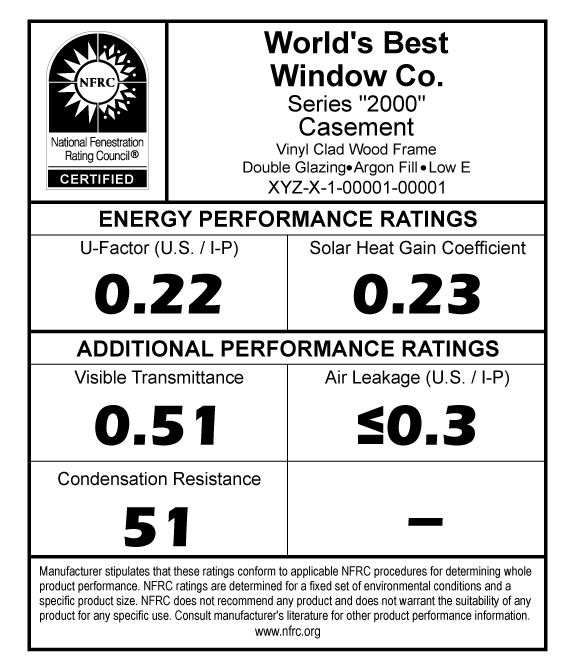
That’s where the National Fenestration Rating Council (NFRC) label comes in. It provides standardized performance ratings that help homeowners compare products using the same measurements. You don’t need to understand every technical detail to use it. A few key numbers can tell you quite a bit about insulation, solar heat gain, and natural light.
What Is the NFRC Label?
The National Fenestration Rating Council is an independent, nonprofit organization that develops standardized methods for rating the energy performance of windows, doors, and skylights.
An NFRC label helps you compare the tested performance of different products. Unlike advertising claims such as “high efficiency” or “premium insulation,” the ratings follow established measurement procedures.
One important distinction: NFRC certification does not automatically mean a window is ENERGY STAR certified. NFRC provides standardized ratings, while ENERGY STAR applies separate efficiency requirements that vary by product and climate zone.
How to Read the Five NFRC Window Ratings
Most homeowners should begin with U-Factor and Solar Heat Gain Coefficient (SHGC). Visible Transmittance provides additional information about daylight, while Air Leakage and Condensation Resistance may appear as optional ratings.
1. U-Factor: How Well Does the Window Insulate?
U-Factor measures the rate of non-solar heat transfer through a window. A lower number means less heat moves through the complete window assembly.
For example, a window rated 0.25 has better insulating performance than a comparable window rated 0.35, assuming both ratings use the same measurement basis.
Look for the whole-window U-Factor, not a glass-only rating. The frame, glass, spacers, and other components all influence performance.
2. Solar Heat Gain Coefficient (SHGC): How Much Solar Heat Gets Through?
SHGC measures how much solar energy enters through a window and contributes to indoor heat gain. It is expressed on a scale from 0 to 1.
- Lower SHGC: Allows less solar heat into the home, which can be useful for controlling summer heat gain.
- Higher SHGC: Allows more solar heat through, which may be beneficial for passive heating in some climates and locations.
In North Georgia, SHGC deserves particular attention for windows receiving strong afternoon sunlight. However, the best choice also depends on shading, window orientation, and the home’s overall heating and cooling needs.
3. Visible Transmittance (VT): How Much Daylight Enters?
Visible Transmittance measures how much visible light passes through a window. The rating ranges from 0 to 1, with higher numbers indicating more transmitted daylight.
This can be important when comparing replacement windows for living rooms, kitchens, or other spaces where natural light is a priority.
Keep in mind that visible light and solar heat are not the same thing. A window can provide useful daylight while limiting some unwanted solar heat gain, depending on its glass package and coatings.
4. Air Leakage (AL): How Much Air Passes Through the Window?
Air Leakage measures the amount of air passing through joints in a window assembly under specified test conditions. Lower numbers indicate less air leakage.
This rating can help you compare how tightly products perform in laboratory testing. It is generally expressed in cubic feet per minute per square foot (cfm/ft²).
Air Leakage is an optional NFRC label rating, so it may not appear on every label. And remember, a good laboratory rating cannot compensate for poor installation or gaps around the window opening.
5. Condensation Resistance: How Does the Window Handle Interior Moisture?
Condensation Resistance is an optional rating that indicates a window’s relative ability to resist condensation forming on interior surfaces. Traditional NFRC condensation resistance ratings use a scale from 0 to 100, with higher values indicating greater resistance.
Even a well-insulated window can experience condensation when indoor humidity is high enough. The rating is useful for comparison, but it does not guarantee that condensation will never occur.
A Simple Example: Comparing Two Window Labels
Suppose you’re comparing two hypothetical replacement windows with the following ratings:
| Rating | Window A | Window B |
|---|---|---|
| U-Factor | 0.25 | 0.32 |
| SHGC | 0.23 | 0.30 |
| Visible Transmittance | 0.48 | 0.55 |
Window A has the lower U-Factor and SHGC, indicating better insulating performance and less solar heat gain. Window B allows more visible daylight.
Neither result automatically tells you which product is right for your home. Window orientation, appearance, installation requirements, and personal preferences can influence the decision.
NFRC vs. ENERGY STAR: What’s the Difference?
NFRC and ENERGY STAR are related, but they serve different purposes.
- NFRC: Provides standardized, independently certified energy performance ratings for comparing products.
- ENERGY STAR: Identifies products meeting specific energy-efficiency requirements for their product category and applicable climate zone.
A product may have certified NFRC performance ratings without carrying an ENERGY STAR label. If certification matters to you, verify the exact window model and glass configuration rather than assuming that every product in a manufacturer’s lineup has the same designation.
For a broader explanation of efficiency standards and what they mean when buying windows, read our guide to U-Factor, SHGC, and ENERGY STAR.
How to Use the NFRC Label When Shopping for Windows
Before accepting a window replacement proposal, consider these steps:
- Ask for the NFRC ratings of the specific window series and glass package being quoted.
- Compare whole-window U-Factor, SHGC, and Visible Transmittance.
- Check whether optional Air Leakage and Condensation Resistance ratings are available.
- Confirm whether the exact product configuration is ENERGY STAR certified, if that’s important to your purchase.
- Review the warranty, frame construction, operating style, and installation scope alongside the ratings.
You can also check product ratings using the NFRC Certified Products Directory.
Making Sense of Window Ratings in North Georgia
Homeowners around Woodstock, Marietta, Roswell, and North Metro Atlanta need windows that can handle hot summers, cooler winter weather, and changing seasonal conditions. The NFRC label offers a starting point for comparing products, but it should be part of a larger conversation about your home.
Pinnacle Window offers replacement-window options, including OKNA vinyl windows and StarMark composite windows. Our team can help you review available performance ratings, product features, and installation considerations before deciding.
Explore our complete window replacement guide for more information about choosing windows, or contact Pinnacle Window to discuss your project. You can also call (770) 928-9922.
